📉 Depreciation7 min read· July 23, 2026
Why New Cars Lose 20% of Their Value Immediately


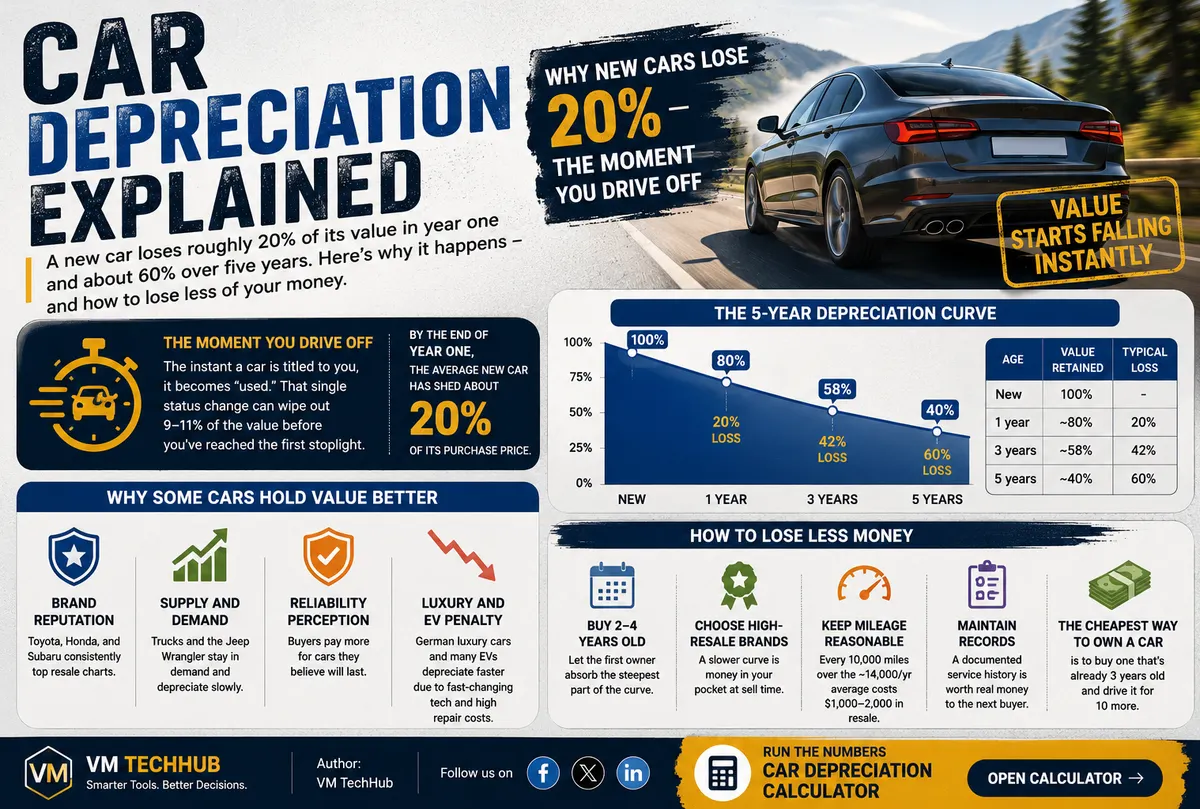
A new car loses roughly 20% of its value in year one and about 60% over five years. Here's why it happens - and how to lose less of your money.
The moment you drive off the lot
The instant a car is titled to you, it becomes "used." That single status change can wipe out 9–11% of the value before you've reached the first stoplight. By the end of year one, the average new car has shed about 20% of its purchase price.
The 5-year depreciation curve
| Age | Value Retained | Typical Loss |
|---|---|---|
| New | 100% | - |
| 1 year | ~80% | 20% |
| 3 years | ~58% | 42% |
| 5 years | ~40% | 60% |
Why some cars hold value better
- Brand reputation - Toyota, Honda, and Subaru consistently top resale charts.
- Supply and demand - trucks and the Jeep Wrangler stay in demand and depreciate slowly.
- Reliability perception - buyers pay more for cars they believe will last.
- Luxury and EV penalty - German luxury cars and many EVs depreciate faster due to fast-changing tech and high repair costs.
How to lose less money
- Buy 2–4 years old. Let the first owner absorb the steepest part of the curve.
- Choose high-resale brands. A slower curve is money in your pocket at sell time.
- Keep mileage reasonable. Every 10,000 miles over the ~14,000/year average costs $1,000–2,000 in resale.
- Maintain records. A documented service history is worth real money to the next buyer.
The cheapest way to own a car is to buy one that's already 3 years old and drive it for 10 more.
Run the numbers
Car Depreciation Calculator